Subscription payment solutions are at the heart of one of today’s most dynamic business models. The global subscription economy is projected to reach $1.5 trillion by 2025, making it one of the fastest-growing segments in digital commerce. For AI and SaaS companies, which increasingly rely on recurring revenue, selecting the right subscription payment platform is no longer optional—it is a strategic necessity.
Yet sustaining recurring payments is not without obstacles. Payinsider’s recent data insights reveal that the two leading causes of failed subscription transactions are:
Insufficient funds in the customer’s account
Outdated or invalid payment credentials (e.g., expired cards or closed accounts)
These seemingly small issues can have outsized consequences, triggering involuntary churn, canceled subscriptions, and lost long-term customer value. In fact, industry studies suggest that failed payments account for 20–40% of overall churn in subscription-based businesses.
The question is clear: How can payment providers and platforms actively reduce churn and protect recurring revenue streams?
Too often, the payments layer is treated as a back-office function, while its potential impact on revenue retention is overlooked. In reality, the effectiveness of a company’s payment solution can be a decisive factor in subscription growth and sustainability.
This guide will examine how payment orchestration platforms address these challenges by:
Automating recurring billing to reduce friction
Leveraging intelligent routing to optimize transaction success rates
Deploying advanced tools such as Smart Dunning, which can recover up to 50% of failed transactions by intelligently retrying payments at the right time and through the right channels
By reframing payments as a strategic growth lever rather than a technical necessity, businesses can position themselves to capture the full potential of the subscription economy.
Understanding Subscription Payment Solutions
The mechanics behind subscription services revolve around specialized platforms that streamline recurring transactions. These systems form the backbone of modern subscription businesses, from Netflix to SaaS/AI companies and everything in between.
What is a subscription payment platform?
A subscription payment platform brings together essential business components—payment processing, customer relationship management, marketing tools, and data analytics—into one unified hub.
This integration eliminates the inefficiencies of switching between multiple systems, streamlining operations for subscription-based businesses. Just as importantly, it centralizes all key data points, empowering companies to make smarter, data-driven decisions that directly impact growth and customer retention.
A subscription payment platform’s core functionality can be divided into two key components: subscription management and payments
1. Subscription Management: Flexibility and Retention
Subscription management empowers merchants with control over recurring billing cycles—whether weekly, monthly, annually, or fully customized. But beyond billing, it also plays a crucial role in reducing churn.
One effective way to retain customers is through automated email notifications triggered at key moments—such as failed payments, upcoming renewals, or subscription cancellations. According to Payinsider Data, merchants recover 10% more revenue by leveraging email recovery features.
The best part? Merchants can test different timeframes and email templates, then use data analytics to identify the most effective strategy for different customer segments. This data-driven approach ensures optimized retention and revenue growth.
2. Payments: The Engine of Revenue
2.1 Multi-Gateway Processing
As your business expands globally, one of the first challenges you face is adapting your products and checkout experience to diverse payment behaviors and to varying regulations around tax and data compliance. Inevitably, this often requires heavy investment in technical integrations with multiple international and domestic payment providers in order to maximize checkout conversion.
Take Brazil as an example. It is the largest e-commerce market in Latin America, yet international cards represent less than 30% of online transactions. Most consumers prefer local payment methods such as:
For a foreign SaaS or subscription company entering Brazil, building direct integrations with each of these methods would be costly, complex, and slow to implement. Without them, however, the business risks extremely low checkout conversion rates, as many customers simply cannot pay with their preferred method.
This is where a payment orchestration platform can provide a solution. By connecting to a broad ecosystem of industry players and leveraging rich transaction data, orchestration platforms enable businesses to achieve greater flexibility, higher success rates, and faster market adaptation—all without the heavy upfront costs of building everything in-house.
2.2 Managing global currencies and tax rules
For SaaS and AI businesses operating internationally, success depends on more than just integrating with multiple gateways to support local payment methods. Customers also expect to pay in their native currencies. If they face unexpected FX fees during checkout, conversion rates can drop significantly.
A subscription orchestration platform addresses this by enabling businesses to set default countries and deploy dynamic local currency strategies—improving both customer experience and transaction success rates.
At the same time, navigating the global tax landscape presents its own maze of challenges. Businesses must comply with sales tax and VAT obligations once they exceed certain economic nexus thresholds, which vary widely by jurisdiction. For instance, in Georgia (U.S.), tax collection is triggered after surpassing $100,000 in revenue or 200 transactions, while other states and countries apply completely different thresholds.
Managing this complexity across jurisdictions can be both difficult and resource-intensive for SaaS and AI companies. That’s why Payinsider goes beyond gateway integrations. Our subscription payment platform also connects seamlessly with tax service providers, giving businesses a unified space to manage payments, compliance, and analytics—removing friction and ensuring sustainable growth across markets.
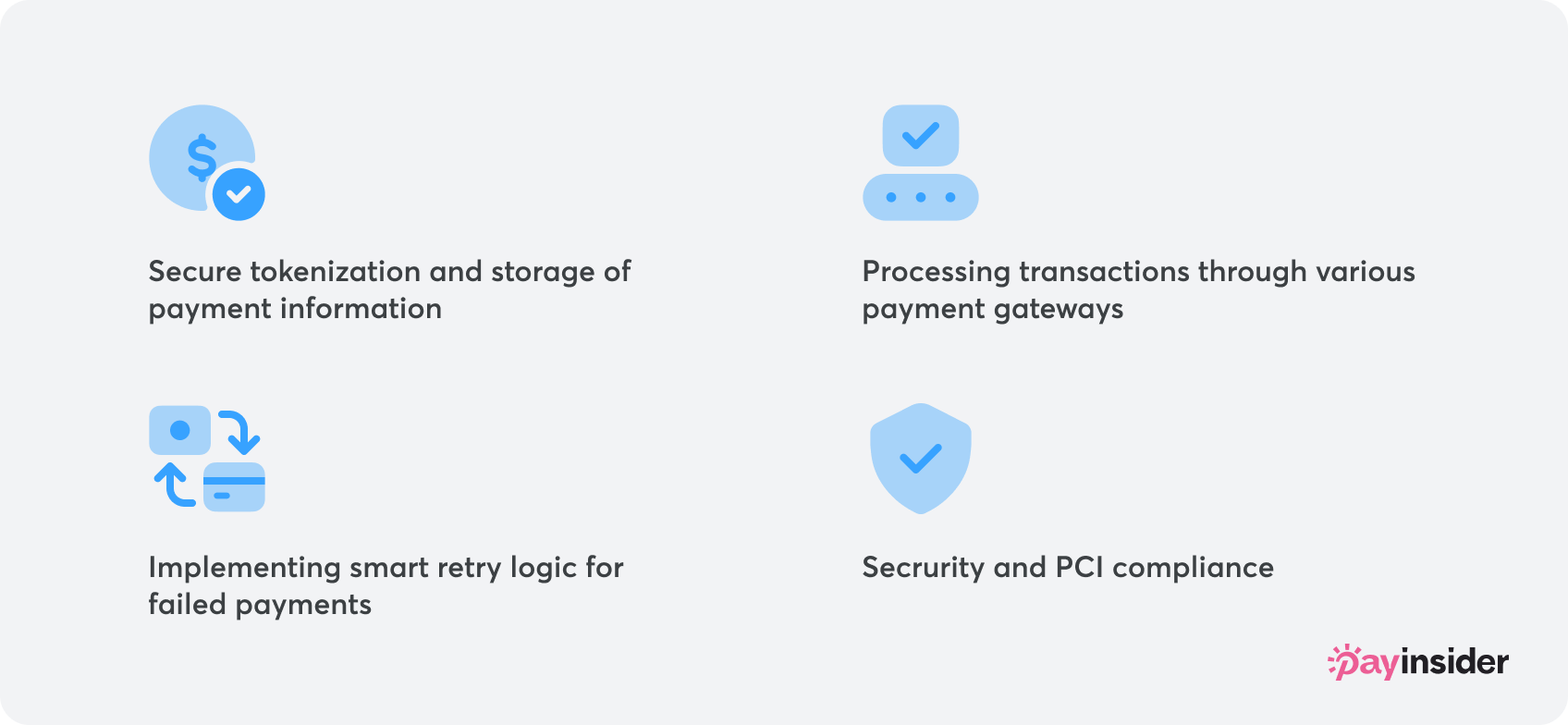
2.3 Security and PCI compliance concerns
For subscription businesses, securely storing customer payment information is critical—not only to enable fast checkout experiences, but also to safeguard against unexpected payment account shutdowns that could result in significant MRR losses. Compared to other industries, uninterrupted payment continuity is especially vital for recurring revenue models.
To achieve this, compliance with the Payment Card Industry Data Security Standard (PCI DSS) is non-negotiable. PCI DSS establishes strict requirements for storing, processing, and transmitting cardholder data. Non-compliance exposes businesses to severe financial penalties, regulatory actions, and reputational damage.
However, obtaining and maintaining PCI DSS Level 1 certification can be prohibitively complex, time-consuming, and expensive for many businesses. This is where payment orchestration platforms provide a critical advantage. With a single integration, the orchestration layer can hold the required certifications on behalf of merchants, ensuring secure, seamless payment processing. By doing so, businesses optimize payment performance, reduce friction, and maximize conversion and transaction success rates—without bearing the full compliance burden themselves.
2.4 Implementing smart retry logic for failed payments
Failed payments and involuntary churn remain one of the biggest frustrations for subscription businesses. These failures typically fall into two categories:
Initial Payments (first purchase):
When customers first attempt to pay, declines may occur due to reasons such as issuer rejection, risk blocks, or “Do Not Honor” responses. In these cases, identifying the error codes and distinguishing between soft declines (retryable) and hard declines is critical. Smart routing can then retry the payment through another gateway, significantly increasing recovery rates.
Recurring Payments (renewals):
The most common reason here is insufficient funds, but there are over 100 possible failure reasons. Without an intelligent retry strategy, these failures quickly lead to lost revenue and churn.
A smart retry logic—leveraging insights from decline codes, retry windows, and gateway optimization—not only helps recover otherwise lost payments but also reduces involuntary churn, protecting recurring revenue streams.
Why 2025 is a turning point for recurring payments
The subscription economy traces its roots back over 580 years to the 15th century, when early print media (like newspapers) pioneered the model. Since then, it has evolved through milestones like telephone services (1870s), SaaS (1999), and streaming (2007)—solidifying its role as one of the most enduring and adaptable pricing models in commerce.
Today, data confirms its unstoppable growth:
Yet challenges loom. With customer acquisition costs rising and conversion rates dropping (4.1% in 2021 → 2.8% in 2024), businesses must prioritize retention and reactivation strategies like never before.
The next frontier? AI-powered subscriptions. From fraud detection to hyper-personalized experiences and predictive behavioral analytics, technology is reshaping how recurring payments thrive.
Key Features to Look for in a Subscription Payment Provider
Selecting the right subscription payment provider can make or break your recurring revenue business. As you evaluate potential platforms, focusing on these essential features will ensure you find a solution that drives growth and reduces operational headaches.
1. Support for multiple payment gateways
For any serious subscription business, the ability to integrate multiple payment gateways is critical. This capability goes beyond simply accepting traditional credit card payments - it enables you to support a diverse range of payment methods including digital wallets and direct bank transfers.
This flexibility is particularly valuable when we consider that 61% of global transactions are now non-card based. But the benefits extend further:
Region-preferred payment methods can boost checkout conversion rates by 5-6%
Payment acceptance rates can improve by 7-10% (Payinsider statistics)
By implementing a multi-gateway solution, subscription businesses can significantly optimize their payment operations while meeting customer preferences across different markets.
Multiple gateways also offer practical benefits:
Extended global reach with support for different currencies and payment methods
Gateway failover redundancy for continuous service during outages
Custom routing options for specific business needs and financial reporting
In-depth analytics for tracking key payment and subscription metrics
2. Automated card updates and dunning tools
Failed payments are one of the biggest sources of revenue loss for subscription businesses. Research shows that 20-40% of churn is involuntary, often caused by expired or declined payment methods.
2.1 Automated Card Updaters
Seamlessly sync with card networks to refresh expired/updated card details
Require zero customer intervention (Visa Account Updater recovers ~30% of failed payments)
2.2 AI-Powered Dunning Management
Customizable retry schedules (optimized by decline reason, customer value, etc.)
Personalized notifications with 1-click payment update options
Smart retry logic that adapts based on:
Platforms with these features see involuntary churn drop from 6% to 1% (Payinsider), recovering thousands in lost revenue. For a $1M ARR business, this could mean $50K+ annual savings.
2.3 Analytics and reporting for churn reduction
Comprehensive analytics capabilities provide crucial visibility into your subscription business health. With this in mind, prioritize platforms that offer detailed metrics on payment failures, churn patterns, and recovery rates.
Advanced systems now leverage AI-powered analytics to predict early warning signs of customer dissatisfaction, enabling proactive measures before cancelation occurs. In particular, cohort analysis tools group customers who subscribed around the same time to help identify when churn typically spikes.
2.4 Flexible billing cycles and plan management
The ability to customize billing cycles to match customer preferences significantly enhances retention. Notably, flexible billing options allow you to offer personalized payment schedules—monthly, quarterly, or annual—adapting to diverse customer needs.
Look for platforms supporting multiple pricing models (tiered, volume-based, or flat rate) and the ability to easily manage upgrades, downgrades, and plan changes. The most advanced solutions also enable mixed interval subscriptions and automated proration calculations when customers switch plans.
Real-World Use Cases and Success Stories
Let's examine real-world examples showing how businesses have successfully implemented advanced subscription payment solutions to overcome common challenges.
Example: Scaling globally with localized payment methods
Almost 75% of companies selling direct to consumers will offer subscription services by 2025, with the global market expected to reach $478.20 billion. Spotify faced challenges when expanding globally yet achieved a 28% increase in successful payment retries by implementing intelligent retry logic based on customer behavior. Offering localized payment experiences is essential—presenting prices in local currencies alone can boost sales by 12%. Furthermore, catering to regional preferences like Pix in Brazil, UPI in India makes a substantial difference.
Conclusion
The subscription economy stands at a pivotal moment as we approach 2025. Throughout this guide, we've seen how subscription payment solutions have evolved from simple recurring billing systems to sophisticated platforms that manage complex customer relationships. Undeniably, businesses face significant challenges—from payment failures causing up to 40% of subscriber churn to the complexities of global taxation and security compliance.
Payment orchestration has emerged as the definitive solution to these obstacles. Through smart retry logic, tokenization, and multi-gateway support, these platforms recover failed payments while reducing PCI compliance burdens. Consequently, businesses can focus on growth rather than paying headaches.
When selecting your subscription payment provider, prioritize platforms offering multiple payment gateways, automated card updates, comprehensive analytics, and flexible billing options. Many leading providers allow you to start it for free, giving you the opportunity to test capabilities before full implementation.













 Scroll to Top